
‘The best way to destroy the capitalist system is to debauch the currency.’
Vladimir Lenin

There's no doubting the fact that trade imbalances have got completely out of hand over the past 2-3 decades. The focus today is on the United States and China, as Donald Trump attempts to use the brute force of tariffs in order to ‘make America great again’. However, the imposition of significant tariffs on international trade, whether as a first move or as retaliation, is really an admission of failure.
It is said that the outbreak of war is the result of the failure of politics, and it leaves everyone worse off. In a very similar way, the imposition of tariffs on international trade is the outcome of failure to allow currencies to float freely, and it too will leave everyone worse off.
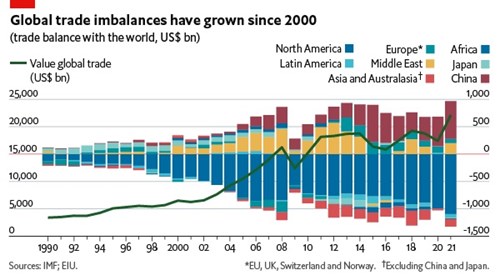 The extent of trade imbalances is crystal clear in this chart from Economic Intelligence. The massive shift to a huge surplus for China and a huge U.S. deficit stands out vividly. As Juliet Samuel wrote in The Times last Thursday, China's determination to become the world's factory has left the West paying the price in lost jobs and mounting debts. It may not have been what Lenin meant by ‘debauching the currency’, but Russia’s communist neighbour’s success in resisting any appreciation of the value of the Renminbi has certainly achieved its objective.
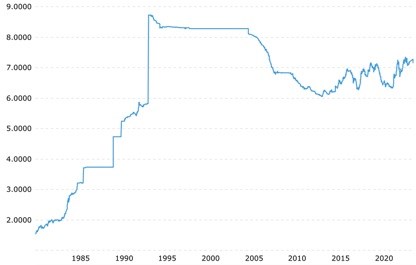 This chart of the US$ versus the Chinese renminbi over the past thirty years is a graphic illustration of the problem. Rather than the exchange rate adjusting to provide commercially competitive pricing between the world's two largest economies, China has deliberately held down its currency’s value in order to deliver cheaper prices for Chinese goods imported into the USA. As the US Treasury recognised in 2019, this was the result of overt manipulation.
For several years running up to the pandemic, I regularly attended Capital Economics' seminars in London. On virtually every occasion, warnings were sounded about the huge trade imbalance between the U.S. and China as the economists warned of its unsustainability. They would draw attention to Chinese manipulation of the exchange rate, but successive American administrations failed to take action.
Was the American government protecting their people from paying the higher prices that would have applied if the US$ had been devalued, or did they think that being the world's reserve currency would somehow protect them forever?
However, manipulated currencies have not just left a trail of woe across the Pacific; many parts of Europe have also suffered real economic damage by currency manipulation. While it’s hard to envisage tariffs being imposed between European countries (including the United Kingdom), the imposition of a common currency without an adequate regional compensation process has led to real damage.
In a sense, the UK has been the one nation to learn the hard way not to try fixing currency rates. In 1992, the then Conservative government tried to align the British £ to the Euro as a prelude for adopting the common currency. It may have been over thirty years ago now, but many will recall the short sharp shock delivered by financial markets (known as 'Black Wednesday'), which showed clearly that this was not a good move. In the years that followed, opposition to further integration with the European Union grew steadily until the Brexit referendum vote in 2016 brought EU membership itself to a shuddering halt.
But you also need to look within the European Union to see the real damage that currency manipulation — in this case, the imposition of a single currency — has caused. Regional failure at the periphery, particularly along the south, has been a recurrent problem. Greece, southern Italy and more recently those parts of Croatia and Eastern Europe which do not attract tourists have turned into economic deserts as people have migrated to find employment.
Single currency areas need strong and accommodating economic controls to balance out regional economic differences. Within the UK, major public services such as HMRC, the BBC and the Department of Transport are located in regions well away from London and the South East — and in the devolved nations — in order to achieve this.
The European Union has neither a strong and accommodating political centre nor the will to relocate such operations: I once asked a German politician if he could ever envisage their taxation department being based in Athens, and he laughed off the very suggestion.
Readers will know that we are active supporters of improved integration between nations and enabling more effective global governance by building its democratic legitimacy. But, until strong and accommodating government is achieved to make adjustment for imbalances, we will continue to need to rely on freely-moving currency markets in order to make the necessary adjustments between stronger and weaker economic regions.
Currency manipulation has denied such an adjustment between China and the United States, so instead Donald Trump is now resorting to massive tariffs to launch a trade war.
Unfortunately, and as a result of three decades of restraint, the impact of any sudden devaluation of the US dollar would be massive, thrusting the U.S. towards short-term inflation and China towards a deflationary depression; so any move towards freely-floating exchange rates would have to be introduced over a period of time. The US dollar’s role as the world's reserve currency may also be severely tested in the process, but this might be the case anyway as the BRICS nations seek to find an alternative.
But freely-floating currencies are surely preferable to resorting to colossal tariff barriers, which will simply drive nations still further apart.
All of this calls for much improved global governance; but this is also under pressure in the Trumpian era. The removal of American co-operation from a wide range of international bodies does not bode well for the next few years. But if we want to see progress with human civilisation, we must keep trying.
Gavin Oldham OBE
Share Radio