
‘They have spiritual values, too, of course, but success is still measured in material terms. In Russia, that's not the case. In Russia, broadly speaking, we talk about moral foundations.’
Vladimir Putin, in the documentary ‘Russia — the Kremlin Putin — 25 years’

Last week the Republican-controlled House of Representatives narrowly passed Donald Trump’s sweeping ‘big, beautiful’ Tax and Spending Bill which will saddle the United States with another $3.8 trillion on top of its existing $36 trillion debt pile over the next decade. The vote further pressurises the stripping of America's coveted triple-A status by the big credit rating agencies, and pushes still more obligation onto future generations.
As we commented on 14th April, U.S. long bond yields are rising well above 5%, as markets see debt continuing to deteriorate and growth continuing to weaken, causing risk premiums to rise. The fact that, in exchange rate terms, the dollar remains 10% lower than in mid-January shows that confidence in U.S. policymaking has significantly deteriorated. As Francesco Pesole, a foreign exchange strategist at ING, said , ’The view is that, with this bill, Trump is playing with fire with the deficit’.
While few people would accept Putin's claim for moral foundations of any kind, his claim that material prosperity is prioritised in western culture is hard to refute. His own amorality is evidenced in violence and repression; however, we also lack a clear moral compass for our capitalist society.
Whether your focus is on the huge polarisation of wealth, particularly when viewed across generations, an irresponsible disregard for climate change, the axing of overseas aid budgets or the focus on narrow parochial self-interest, secular democratic societies struggle to hold onto a moral compass while their former Christian principles are often sidelined.
The lack of a moral compass extends beyond broad-based government policies, right through to the ways in which innovation and change so often overlook proper regard for those in the poorest communities. We see this, for example, in the functioning of the European Union, where the prosperous middle has failed to make proper provision for the impoverished South in areas where tourism cannot provide compensation.
But it's also evident in the United Kingdom, and last weekend The Sunday Times drew attention to one such area. Leaving aside Trump's exhortations to ‘Drill, Baby, Drill’, many people throughout society want to make their contribution to holding back climate change, and they know that electric vehicles are one of the main routes to achieve this.
If you live in a rural situation or possess a front drive or garage, there is no problem with plugging into your home sockets or fitting a ‘Pod Point’ for a faster charge. However, if you live in a flat or in terraced housing, as will be the case for most people in disadvantaged situations, these options will not be available: public charging is the only alternative. About 9.6 million households in the UK, equal to 35%, do not have off-street parking, according to the RAC Foundation.
The Sunday Times article, ‘Going electric may cost you ten times more if you can't charge up at home’, shows how business profiteering is excluding huge numbers of people from pursuing ethically responsible — and cheaper — transport solutions. Fast public charging costs about 80p per kWh compared with the 6.5p per kWh typically applied for home charging. The chart below shows the huge differential between fast public charging and the typical home EV tariff, and that, even for slow public charging, the cost will be the same as for petrol cars.
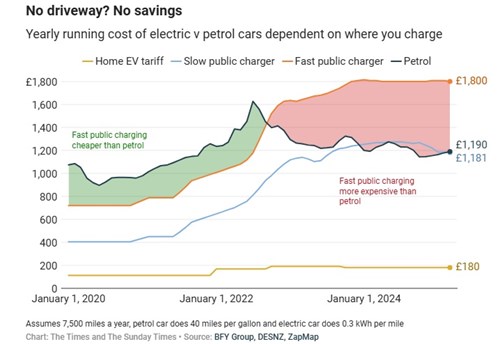
It's well known that the cost of wind and solar electricity generation is significantly lower than that of fossil fuels: it’s interesting to note how Republican-dominated States are the main suppliers of alternative energy in America, whatever their leader says about drilling for more oil. It's also the logic behind X-Links, the massive power generation venture which is now nearing completion in western Africa.
But, somehow, governments seem unable to find a way of holding back the extent of business profiteering which is preventing people from low-income and disadvantaged backgrounds from enjoying the benefits of using clean energy for their vehicles. Recent initiatives in the UK such as reducing the cap on electricity charges may help with general household energy bills, but they don't tackle the premiums that people from disadvantaged backgrounds have to pay for electric vehicle use. There's even a four-times VAT differential between home charging (5%) and public charging (20%).
This is but one small example of how capitalism disadvantages poorer people, but there are so many others in almost every walk of life. Indeed, the widespread use of flat fees as opposed to ad-valorem charging has given digital technology businesses carte blanche for offering particular advantages for the wealthy.
Our approach to making capitalism egalitarian is ‘macro’ in its scope, in contrast to these specific examples. Its concentration on inter-generational rebalancing and ‘Stock for Data’ seeks constitutional change which will deliver participation and opportunity for all, rather than fair pricing; but they are based on the same moral compass that we seek for everyday business and government regulation.
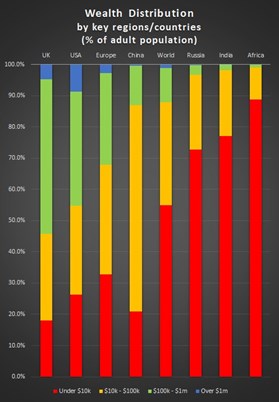 We should not let Putin claim moral superiority over the West in any respect. In fact, the Credit Suisse Global Wealth analysis shows that Russia treats its people economically much worse than the West: China is also significantly better. But we do need to establish a real concern for the poor and disadvantaged which should be evidenced in all walks of life, not just in community service charitable activities.
Gavin Oldham OBE
Share Radio