
‘The property of a complex system whose behaviour is so unpredictable as to appear random, owing to great sensitivity to small changes in conditions.’
Definition of ‘Chaos’

We knew we were in for a bumpy ride when Donald Trump returned to The White House for his second term. We all heard him proclaiming the wonders of tariffs during his election campaign, well before his ‘Liberation Day’ announcement nearly a year ago.
Many probably thought that this gave him a mandate to do exactly as he liked. However, the U.S. Supreme Court, notwithstanding its array of Trump nominees, clearly thought otherwise.
However, he still has his 150-day authority to hang on to: so, on Friday it was a global 10% tariff to be imposed under ‘Section 122’ legislation, then on Saturday it was a global 15%. Meanwhile, no-one has a clue as to whether $180 billion of tariffs already paid will be refunded (even if they are, they will be unlikely to reach U.S. consumers).
If this isn't economic chaos, it's hard to think what is. However, there are still two massive white elephants in the global room so far as America is concerned, and they've both got a bit larger as a result of this mess over tariffs.
The first white elephant is the chronic trade deficit, which Donald Trump has been trying to address. This is a problem which goes back for nearly thirty years, and I recall frequent Capital Economics' seminars in London when Roger Bootle would point to its growing threat, and the fact that something had to be done to resolve it.
It's the result of huge, cheap production flowing particularly out of China at an artificially low exchange rate, with which American producers could simply not compete. Reserve currency status for the U.S. dollar has certainly contributed to the problem: but it's only in the past two years, as Trump has tried to wave his unconventional wand, that the U.S. dollar exchange rate has collapsed:
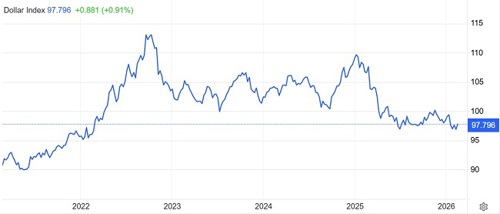
Image source: Trading Economics
Trump is therefore right to try to do something about restoring the trade balance between U.S. imports and exports. However, as we commented a year ago, longstanding and chronic issues such as these should be tackled with cross-party agreement, not by signing Executive Orders. Because there's been no consensus between Trump's Republicans and the opposition Democrats, he cannot turn to Congress to ratify his tariff plans: hence the decision of the Supreme Court, which knows that approval by Congress is required by law.
The problem is now, of course, that Donald Trump’s unilateral imposition of tariffs in April last year has led to a significant increase in consumer prices on Main Street throughout the U.S, and members of Congress would therefore be very reluctant to fall in behind his tariff strategy because of its unpopularity.
As a result, the United States is economically between a rock and a hard place; and that slender 150-day exemption from Congress approval will be gone by the end of July.
Something must be done to resolve their massive trade deficit, and at present it looks as if the falling U.S. dollar exchange rate will have to do most of that work.
However — further significant falls in the exchange rate will also have their consequences. Retail prices will rise still further, interest rate reductions will not be on the cards, and Treasury Bond yields will also rise, potentially to unsustainable levels.
And that brings us to the second white elephant — the sheer scale of American public debt, which is now heading swiftly towards $40 trillion, at a rate of roughly an additional $1 trillion every one hundred days. In this context, the question of whether those $180 billion-worth of incorrectly-charged tariffs will be refunded pales into insignificance: the fact is that U.S. public debt is already at a thoroughly unsustainable level.
I attended an investment committee meeting last week where the visiting investment managers forecast that U.S. debt will soar to 250% of Gross Domestic Product over the next twenty years. I asked what the potential market options might be in response to this, and there was no response.
It’s clear, however, that one of the potential outcomes is a financial market meltdown, as we forecast last year: are there any others?
American lawmakers really have to sit down together and face up to these challenges. It's no good Trump throwing his toys out of the pram: he may not still be with us in twenty years’ time, but the leader of the free world has really got to do better in respect of resolving America's economic challenges, by reaching for an all-party agreement on the way forward.
We've drawn attention in the past to the major Achilles’ heels which undermine democratic politics: in the United Kingdom they include universal welfare, which is not a problem that the United States shares. However, the really big one is short-termism, and that's the reason why both the U.S. trade deficit and their public debt have reached such alarming levels.
With economic chaos now staring us in the face, perhaps Trump should turn his hand to forming a Board of Cross-Party Economic Peace, and leave it to a re-invigorated United Nations to tackle all the other global problems.
Gavin Oldham OBE
Share Radio