
‘Some describe [egalitarian capitalism] as a system where "people from all walks of life have the opportunity to experience a genuine sense of ownership and to feel in control of their own destiny".’
Share Radio: ‘ Egalitarian Capitalism: A World of Individual opportunity’

Our name ‘Share’ has always been somewhat of a ‘double-entendre’ for me, carrying with it the dual benefit of participation in ownership (a key part of equity shares) and generosity of spirit, which brings with it the wonderful capability to generate abundance, as illustrated in the biblical story of the feeding of the 5,000. With ownership comes responsibility, and that is surely worth pursuing for as many people as possible, so that they can feel a sense of responsibility for the world in which we all live. However, all this is for individual application — it's not for governments to seek to act as a proxy for people in this respect.
In 1986, I wrote to Margaret Thatcher with a proposal for ‘Popular Inheritance’, my first initiative for inter-generational rebalancing. She sent quite a substantive and receptive reply, but there was no action. So, when the UK government changed in 1997, I sent my re-worked proposal named ‘Youth Legacy’ to Gordon Brown, in pursuit of breaking the cycle of deprivation.
I don’t know whether it found its mark in HM Treasury, but four years later the Child Trust Fund scheme was announced: the closest I could have hoped for to my original proposal. So, in 2005, we formed The Share Foundation to raise extra funds for the CTF accounts of young people in care. Then, in 2011 and following the next change of government, The Share Foundation campaigned with Action for Children and Barnardos for a new Junior ISA scheme for young people in care. The Share Foundation was accepted as its administrator, and has been operating this scheme for the past thirteen years.
My quest for a more egalitarian form of capitalism now has several key elements, all enabled as a result of The Share Centre, the retail investment business which I established in 1990 and which was merged into Aberdeen in 2022. There are now two distinct charities, The Share Foundation and Share Alliance (with the trading name of Share Institute), the SHARE research project in Cambridge and, of course, Share Radio.
The Share Foundation is firmly focused on inter-generational rebalancing within The United Kingdom: Share Institute and the SHARE research project are global in their perspective, and they include research into ‘Stock for Data and Creativity’.
This commentary provides our report on progress up to autumn 2025. There's a summary of The Share Foundation’s progress and access to its annual report, which is released this week. After that, there are some details of progress with Share Institute and the SHARE research project.
The Share Foundation 2025
It's been an eventful year for The Share Foundation, whose printed annual report is being sent to Members of both Houses of Parliament and to all Heads of Children’s Services throughout UK Local Authorities and Health Trusts over the next few days. Its title is ‘Working with Government to Empower Young People for a Brighter Future’, and it sets out how The Share Foundation’s partnership has enabled Government to become a catalyst for very substantial changes for young people in care and for young owners of Child Trust Funds.
This has included a real focus on ensuring that starter capital accounts are properly delivered to their young adult owners, and in the provision of incentivised learning life skills which significantly reduce the percentage of adult care leavers who are NEET (Not in Education, Employment or Training).
In October, The Share Foundation has also welcomed three new trustees to its board, including:
- Simon Larter Evans, Principal of Tring Park School, and whose contribution to the new ‘Stepping Forward’ programme has resulted not only in introducing young people in care to the performing arts but also in providing them with major transferable skills such as communication and confidence;
- Fiona Ross, education consultant, author, mentor, teacher, and project manager, who has been a key part of The Share Foundation’s Child Trust Fund Ambassador Programme over the past six years and whose work in leading financial awareness in Citizens Advice has been inspirational; and
- Chris Kenna, creative AI entrepreneur and chief executive, media leader and keynote speaker and diversity advocate who, following his childhood and adolescent experience in care, spent seven years in the British Army before launching a new and very successful career as an entrepreneur.
The Share Foundation’s team has worked tirelessly over the past year, and here are some of its key achievements:
- For young people generally, an accelerating rate of helping Child Trust Fund owners to find their accounts. So far, that has resulted in linking over 100,000 young people with their accounts, worth nearly £1/4 billion;
- For young people in care, encouraging local authorities and health trusts to make additional contributions to the accounts which have been opened with central government £200 grants. The total value of these contributions is already double the annual value of the account-opening grants, and there’s scope to build this much further;
- For adult care leavers, a pro-active programme of signing bi-lateral agreements with individual local authorities and health trusts which enables The Share Foundation (whose contracted role ends at 18) to continue with its work to ensure that their accounts are delivered effectively;
- Over two thousand young people in care have now benefited from The Share Foundation’s philanthropically-funded, incentivised learning financial education programme, Stepladder Plus, with over 64% taking at least four out of its six steps. This programme has thus far saved over £12m in public expenditure on welfare and unemployment benefits;
- Launching the new Stepping Forward programme for young people in care, which has already seen over 64 participants, and which will be followed with a generally available public version in the near future.
In return for the Government's annual commitment of nearly £4m, The Share Foundation is therefore already enabling additional contributions and reduced public spending of over £10m per annum — a combined total of £35m to date. That's why The Share Foundation can show its appreciation for Government acting as a catalyst, and not just a funder, for its work.
There are, however, several key respects in which Government could take action to improve inter-generational rebalancing:
- Automatic release of HMRC-allocated Child Trust Fund accounts at the age of 21. This would enable well over £1 billion worth of accounts, the majority of which belongs to low-income young adults, to be delivered to their rightful owners by the end of the current parliament. Cost to Government: negligible.
- CTF Mark 2: The Share Foundation has offered to set up a philanthropically-funded scheme for young people from low-income backgrounds generally, complete with embedded incentivised life skills learning and automatic release at 21. It needs Government regulation and logistics to get underway, but little else. Cost to Government: negligible.
- Acceptance of the role for incentivised learning in providing more opportunities for disadvantaged young adults in the workplace by reducing NEET rates significantly. This requires closer liaison between the Department for Education and the Department for Work and Pensions, so that the benefits accruing to the latter can empower the former with funding for use more generally.
In summary, it's been a dynamic year for The Share Foundation, which can now demonstrate the real benefit of its non-experimental evaluation process: putting inter-generational rebalancing plans into action and proving them in scale.
Share Institute and the SHARE research project
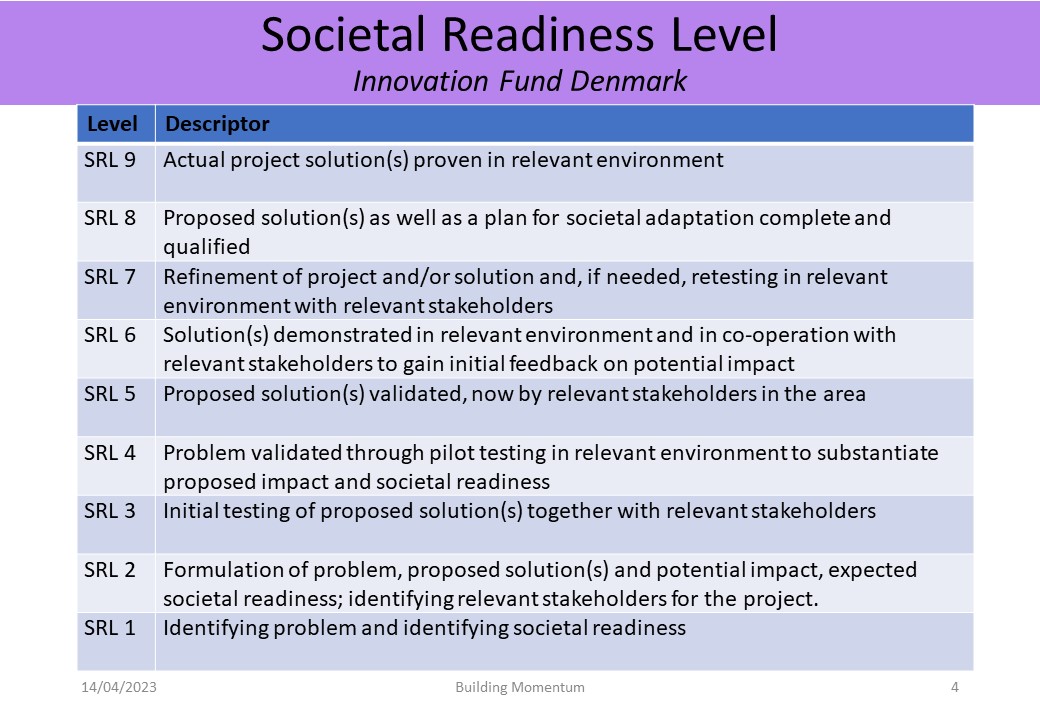 in April 2023, our first SHARE conference was held at King's College Cambridge, and Dr. David Good, who was then coordinating our research programme, presented a chart of societal readiness levels on a scale of 1 to 9. He described The Share Foundation's work on inter-generational rebalancing as at level 4/5, while ‘Stock for Data’ was beginning life at level 1/2.
At the global level, there has been little progress with inter-generational rebalancing. However this will hopefully change significantly in 2026, with a new plan to convene a London-based conference in late spring, potentially at the Institute of Fiscal Studies. This will be followed by a research report, leading onto a new ‘post-doc’ appointment at King’s in 2027.
‘Stock for Data and Creativity’ has, however, made considerable progress over the past two years. Dr. Heloïse Greeff has led this research, producing a Phase 1 research report setting out its logic and describing the issues which need to be addressed. Following its publication, Phase 2 plans to build a simulation engine to enable more extensive research. This phase will be supported jointly by Share Institute and King's College, and it will be preceded by an exercise in economic modelling in order to demonstrate the wider potential of the proposal.
There will then need to be a series of discussions about how to progress with this major proposal offering an alternative to the concept of Universal Basic Income. It will need to be considered in review meetings including the more enlightened tech leaders and regulators. However, many of our current issues of concern, including the massive level of harvesting data and creativity and the loss of employment opportunities — particularly for young people — are already very much in the spotlight.
Changing the world's economic systems is not an overnight task, but we are making progress.
Gavin Oldham OBE
Share Radio