
‘Has the time come for the services of the welfare state to apply only to those in real need; or should the minimum standard be raised to meet the increasing demands of the average citizen?’
Kathleen Heasman, from her 1965 book ‘Christians and Social Work’ (p 40)

It's extraordinary to think that this quotation was written sixty years ago, just twenty years after Clement Attlee introduced universal welfare following the ravages of the Second World War. Up until 1940, the Church had been the primary provider of health services, housing and old people's welfare for the poor: but the massive disruption caused by nearly six years of European conflict resulted in the combination of rising poverty and much fewer resources. It was therefore understandable that Archbishop Temple welcomed the state provision of welfare services.
However, Kathleen Heasman clearly understood, even in the mid-1960s, that there should be a limit to universality; something that the three significant periods of Labour Government since then have found hard to recognise. Their underlying principle seems to be driven by Karl Marx rather than the needs of the poor and disadvantaged, while the Conservative Party has viewed ‘free at the point of use’ welfare as a necessary bribe for electoral support, particularly for the elderly.
As a result, the burden of public spending has driven public debt up to astronomic levels, and we now approach the forthcoming Budget in the face of repeated calls for more and more tax.
But the answer is so simple: don't spend public money on providing free health services, education, transport (for example, bus travel), and winter fuel support for those who are perfectly able to pay for their own needs.
I put the question, ‘What is the overall cost of universal welfare in the United Kingdom, compared to a targeted welfare system?’ into Google AI. Its response focused on universal credit, the state pension and child benefit. It completely overlooked the largest two demands on public welfare spending: state-funded provision of health services and education.
The mean equivalent household income (before taxes and benefits) for the richest fifth of the UK population was £114,300 in the financial year ending ’23, according to the Office for National Statistics. At this level and above, all such households should be capable of paying for their own health insurance and education services.
However, it is a fact that only 10-13% of the UK population have some form of private health insurance or pay for private treatment ‘out of pocket’; this is heavily weighted towards those in work, as that percentage drops to just 5% for those aged 75 and over.
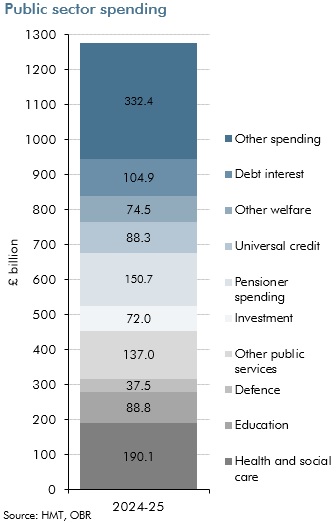 Health and Social Care spending amounted to £190 billion In 2024/25. So if, as we showed in ‘Health and the Economy’ in October ’22, there is a 50:50 split of the need for support for those in retirement age and those below that stage of life, and if the wealthiest 20% of households were required to have mandatory health insurance which could be drawn down on by the National Health Service as its services were used, it suggests that Government health spending could be re-imbursed each year as follows:
|
£190 bn x 50% x (20% - 5%) = |
£14 bn |
|
£190 bn x 50% x (20% - 15%) = |
£5 bn |
|
Potential healthcare re-imbursement: |
£19 bn |
Turning to education, the overall percentage of those making use of private schools is 6%. If, therefore, the wealthiest 20% of the population were required to re-imburse the cost of using state schools, a further £12 bn could be generated from applying a targeted, rather than universal, approach to the provision of state education.
Plus, returning to those other areas of welfare spending, there is probably a further £9bn-worth of savings which could be generated by moving away from universal as opposed to targeted welfare, and that would be without touching the state pension.
Wealthier people will not leave the country because they are asked to pay for health care, education and other welfare services, which they know that they can afford. However, they will leave the country — and have already started to do so in substantial numbers, if income and capital taxes are increased still further in order to raise the same £40bn which could be achieved by ending universal welfare. The long-term freezing of income tax thresholds has already caused immense damage; this was well-explained by This Is Money in their 13th September episode.
In a fortnight's time the Chancellor will tell us how she intends to meet this challenge, the context for which she tried to describe in that early morning press briefing last week. However, rather than raising taxes still further, this is her opportunity to say farewell to Attleean universality, as Kathleen Heasman proposed sixty years ago. It's a tragedy that she was not listened to at that time, because we could have avoided building this massive public debt burden: the interest cost of which is already costing well over £100 billion per annum.
Targeted welfare, together with the key aspects of our proposals for egalitarian capitalism — inter-generational rebalancing (which should be funded from IHT receipts) and Stock for Data — would remove the scourge of poverty and give new hope for young people. Let's move forward to a more equitable society, and say farewell to quasi-Marxism.
Gavin Oldham OBE
Share Radio