
‘The NHS is the closest thing the English people have to a religion.’
Nigel Lawson

Following Sunak’s crass misjudgement in returning early from the D-Day 80th anniversary in Normandy, it's now inconceivable that his prediction of a hung parliament will result from the UK General Election on 4th July; that is, unless he voluntarily steps down from his role as Conservative party leader, as suggested by Matthew Parris in The Times last Saturday. So, looking at the likelihood of at least five years of Labour Government, we need to look closely at Sir Keir Starmer's proposals (so far as possible, as there's not much to see just yet).
One thing he has been specific about is his total addiction to the National Health Service, even to the extent of refusing to consider allowing his close relatives to receive private medical care in the event of an emergency. Asked whether he was a socialist he responded ‘yes’, and he is clearly content to give that a higher priority than the potential imminent death of one of his family.
When the welfare state was first established by the Attlee Government, the Church had been providing the only access to healthcare for the poor; and its capacity to help was severely impacted by WW2. There's a detailed account of how this part of its pre-war mission was delivered, in Kathleen Heasman’s book ‘Christians and Social Work’.
As a result, there was understandably a sigh of relief when the National Health Service was first established after the war ended, and Archbishop Temple even went so far as to describe the State as doing God's work. Unfortunately, however, its funding was not targeted according to ability to pay: it was based on the socialist creed of universality introduced by communism. Fast forward seventy-five years and we can now see how it's actually denying those most in need from receiving a good service, by holding on to that mantra of universality, ‘free at the point of use’.
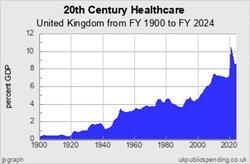 Why does universality not work? Firstly, because it totally cripples the public sector with its huge demand for cash. Secondly, because it provides monopoly services — thus no choice for patients, and it thereby grants its employees a total stranglehold in negotiations over remuneration and working conditions.
Chart source: https://www.ukpublicspending.co.uk/healthcare_spending).
We all want to see a first-class health service, funded by the State for those who cannot afford, or whose employers do not provide, private health insurance. However, providing that same service for everyone with no relation to their ability to pay, is just nonsense — we all know this, including Gen Z: see Janice Turner's article, ‘Sorry Starmer, we're losing our NHS religion’ published in The Times on 8th June.
So Sir Keir Starmer needs to drop his ‘I am a socialist’ declaration, and to accept that ability to pay is a reasonable yardstick for requiring people to have mandatory private health insurance if their employer doesn’t already provide it, which can then be drawn down as they use the National Health Service just as for a private GP or clinic.
Our commentaries have focused on this several times over the past couple of years: here's an initial analysis (17th October 2022) directed at Jeremy Hunt following his long time as Secretary of State for Health, and shortly after taking on his new role as Chancellor of the Exchequer.
However, the Conservatives wouldn't dare to upset their elderly support base by introducing mandatory private health insurance for wealthy old folk. For the Tories, free health care for the wealthy has become an electoral bribe by any other name. That’s why we suggested a cross-party agreement on 25th March this year, but of course no action was taken on that.
It should now, therefore, be done by this incoming Labour Government, and Starmer’s team should waste no time in dispensing with universal free healthcare and its socialist foundation.
As patients from all backgrounds increasingly see that choice is open to them, they will reasonably expect to be able to use private GPs and clinics as an alternative to the NHS; these facilities should be available for those who qualify for State-funded health care via an appropriate voucher process. This also means that medical records must be shared between the NHS and those private GPs and clinics, in order to ensure that proper diagnostics are available at all times.
Unless a change of this magnitude is undertaken, the United Kingdom will continue to struggle under its huge mountain of public debt and high taxation. This is our real problem — it's not migration, and it's not the legacy of Brexit: it’s the legacy of seventy-five years of socialism, with its huge deadweight of publicly-funded intermediation.
Although the introduction of mandatory private health insurance can be arranged swiftly, it will take several years for patient choice to be generally available — but it will happen. Meanwhile the taxes which are currently holding back economic growth and individual empowerment can be gradually eased, enabling working people and entrepreneurs to re-discover the benefits of a vibrant economy.
It's extraordinary how political parties think that short-term electoral give-aways are sufficient to win votes, as if the general public is incapable of understanding long-term issues such as the dysfunctional nature of the NHS. All parties are guilty of this misconception — but these big, long-term issues have to be addressed. Let's make a start by dispensing with the socialist mantra of universality, and by providing properly-targeted support for those who can't afford to pay for their health care via mandatory private health insurance.
Gavin Oldham OBE
Share Radio